Google Wave
I finally got a Google Wave account and I decided to do something for the community. More precisely, the hacker/tinkerer/DIY community.
I think it would be rather interesting to have a place where to share, showcase and discuss projects and hacks with local people (from Montreal).
If you want to join the wave you can find it here.
I hope this will result in a stronger more connected Montreal Hacker community.
Cheers, and see you on the wave!
I have a few Wave invites left so if any geeky Montrealer would like one, please leave a comment and I’ll see what I can do.

Xilinx Spartan
I spent countless hours trying to install the free version of the Xilinx software on may windoze Virtual machine and I have finally succeed.
I must say that although I have never used Xilinx ISE Webpack, I already hate it. It come in a huge installation archive (2.7 GB) and an equally huge update archive (2.4 GB). The option to use the “slim” installer (88 MB) is worthless since there is no ways of saving the required files for an eventual reinstallation (which was needed twice in my case).
Anyway, after installing/uninstalling/installing many times I finally got it to work. And this very lengthy and painful process reminded me why the Open Source world is so much more convenient. Installing a full linux distribution with tons of extra programs takes half the required storage and a third of the time. Too bad FPGA programming tools are ruled by the chip manufacturers.
All this painful process was required in order to get my new NanoBoard 3000 running. Hopefully I wont have to use Xilinx ISE anytime soon. Altium Designer was much easier to install and requires less storage.
I know this has been said before, but I cannot find it, so here it goes again.
Ever since I got my EeePC, I got obsessed by the amount of screen real-state Firefox takes for the top menu, browsing control buttons, address and search bar, etc.
The quickest fix I always apply every time I am in front of a Firefox windows that is not mine is to move the Bookmarks toolbar content right next to the File menu and to disable the Bookmarks toolbar. This removes one full toolbar, and unless you have a really heavily populated Bookmarks toolbar, should function very well.
But I wanted to go further (especially since I saw that Chrome uses less screen real-state). So I installed a few add-ons that make a significant difference:
- AHS. autoHideStatusbar does precisely that. It hides the status bar unless it is required (i.e. a page is loading or you hover a link) or you go near it with the mouse pointer.
- Smart Stop/Reload. It combines the Stop and Reload buttons (since they are never used at he same time).
- Tiny Menu. It transforms the File menu into a single item. This extension saves a lot of real-state and the menu remains nice ans usable.
By using these extensions and moving things around in the toolbars, you can achieve a very tiny navigation interface that is perfectly usable.

Tiny Firefox
Note the Tux theme (I a’m using Personas)
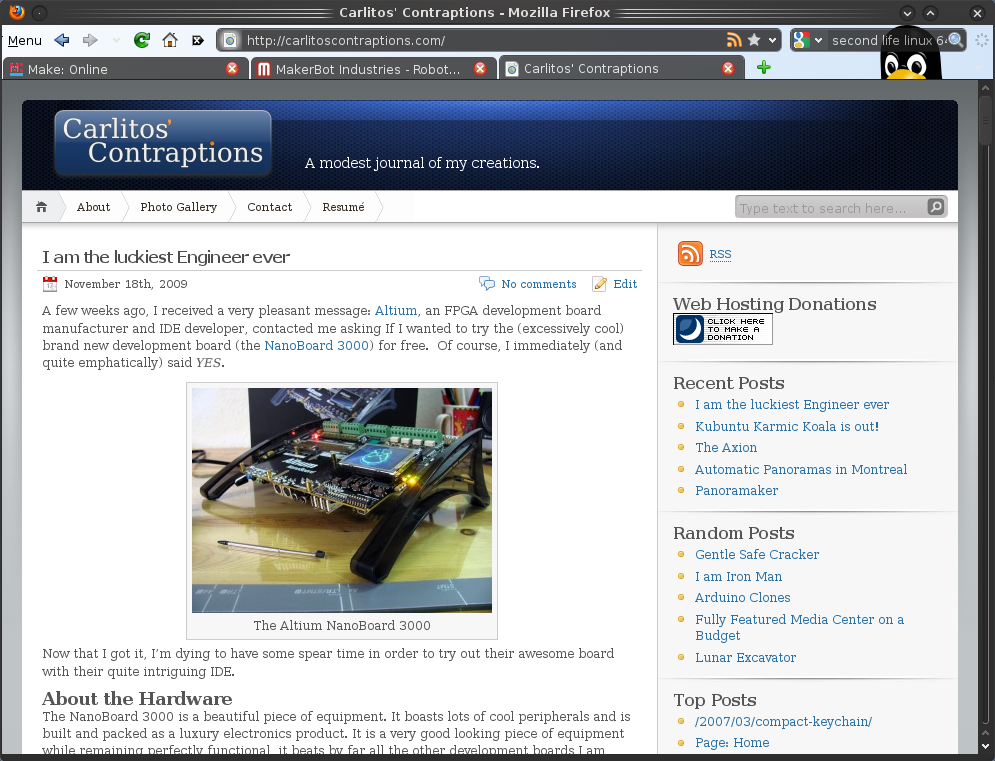
A few weeks ago, I received a very pleasant message: Altium, an FPGA development board manufacturer and IDE developer, contacted me asking If I wanted to try the (excessively cool) brand new development board (the NanoBoard 3000) for free. Of course, I immediately (and quite emphatically) said YES.

The Altium NanoBoard 3000
Now that I got it, I’m dying to have some spear time in order to try out their awesome board with their quite intriguing IDE.
About the Hardware
The NanoBoard 3000 is a beautiful piece of equipment. It boasts lots of cool peripherals and is built and packed as a luxury electronics product. It is a very good looking piece of equipment while remaining perfectly functional, it beats by far all the other development boards I am familiar with (i.e. the Altera DE2 board and the Lattice Mico32 development board) while remaining much cheaper (around 50% of their price).

NanoBoard 3000 Unboxing
Features
Here is a selection of the NanoBoard’s features from Altium’s Wiki I find most prominent:
- A Xilinx Spartan-3AN device (XC3S1400AN-4FGG676C)

Nanoboard 3000 Front
- 4 Serial SPI Flash memory devices
- Programmable clock 6 to 200 MHz, accessible by Altium Designer or by an FPGA design
- SPI Real-Time Clock with 3V battery backup
- Adjustable voltage regulators set to generate 1.2V, 1.8V, 2.5V and 3.3V power
- 256K x 32-bit common-bus SRAM (1MB)
- 16M x 32-bit common-bus SDRAM (64MB)
- 8M x 16-bit common-bus 3.0V Page Mode Flash memory (16MB)
- Dual 256K x 16-bit independent SRAM (512KB each)
- 256K x 16-bit independent SRAM (512KB)
- 8 RGB LEDS
- 5 generic push-button switches
- 4-channel 8-bit ADC, SPI-compatible
- 4-channel 8-bit DAC, SPI-compatible
- 4x isolated IM Relay channels
- 4x PWM power drivers
- Screw terminal headers for ADC/DAC/Relay/PWM interfaces
- SD (Secure Digital) card readers:
- One for use by the Host Controller FPGA
- One for use by the User FPGA
- SVGA interface (24-bit, 80MHz)

NanoBoard 3000 Back
- 10/100 Fast Ethernet interface
- USB 2.0 High-Speed interface
- RS-232 Serial Port – DB9M
- RS-485 Serial Port – ‘RJ45′
- 240 x 320 TFT LCD with touch screen
- 8-way DIP-switch
- Stereo 2W audio power amplifier with 3.5mm test input jack and DC volume control
- 24-bit Stereo Audio CODEC with I2S-compatible interface
- Stereo audio jacks (3.5mm):
- Line In / Line Out
- Headphones
- Speakers on a separate (attached) board
- MIDI interface
- Diagnostics interface – PCI Express (PCIe) edge connector for connection of automated test equipment (ATE)
- 1.8″ ATA/IDE connector providing access to user LED and generic switch I/O
- Remote Control and IR interface.
I should post some further details and perhaps even a simple test project soon (as soon as I get Altium Designer and Xilinx ISE installed and running)